Leadership in Action: Behaviors that Matter

Leadership in Action: Behaviors that Matter

Bold Beginnings

Leadership is defined less by titles and more by behaviors.

This issue challenges you to examine the daily actions that signal credibility, inspire trust, and shape culture. By focusing on what leaders do, you can cultivate habits that speak louder than any position you hold.

Leadership Lens – Everyday Audacity

Leadership is not a title; it is a set of consistent actions that inspire trust, guide others, and move work forward.

Whether you lead a team of two or a division of two hundred, the way you behave under pressure, in meetings, and during day-to-day interactions tells people more about your leadership than any organizational chart.

Resource Spotlight – Leadership Behaviors Checklist

This practical tool outlines the most impactful leadership actions—from modeling accountability to creating space for diverse voices. Use it to self-assess, gather peer feedback, or set development goals for yourself and others.

Leadership Behaviors Checklist.pdf​

Reflection

  • Which leadership behaviors come most naturally to you?
  • Which ones are you consciously working on right now?
  • How can you model these behaviors for others in your circle of influence?

Audacity in Action

A regional manager asked her team to anonymously rate her on the Leadership Behaviors Checklist.

While she scored high on strategic thinking, she discovered she wasn’t perceived as approachable. By intentionally increasing her open-door time and inviting input early, she improved team trust scores by 22% in the next engagement survey.

Lead Boldly – Quick Wins

Here are some quick actions and mindset resets you can apply immediately for a leadership boost:

One bold action to take this week
Pick one behavior from the checklist to strengthen and practice daily.
Why it matters: · Small, intentional changes compound into credibility and trust.

Your Clarity Phrase This Week
“Here’s what I’m doing differently, and here’s why.”
Why it matters: · Transparency about your efforts builds trust and models growth.

One mindset reminder
Consistency in action speaks louder than words.
Why it matters: People trust patterns, not promises.

Share This Issue

Enjoyed this issue? Forward it to someone who leads boldly.
Subscribe here →
Click here for further leadership insights

Your leadership journey deserves more than intention; it deserves action.
Book your complimentary Discovery Session below and begin leading boldly with clarity, confidence, and conviction.

Until next time, lead boldly, lead audaciously!

Connect

Stay connected for insights that help you lead with clarity, confidence, and conviction:
Tag us: #AudacityLeadership #DrBolaFashola

Leadership as Architecture: Why Execution Stability Is a Design Variable

Leadership as Architecture: Why Execution Stability Is a Design Variable

Leadership is often evaluated through the lens of vision, influence, or individual capability.

However, in many organizations, performance does not falter due to intent; rather, it fails when execution relies on individual personalities rather than effective design.

This is a structural problem, not a motivational one. Execution stability is not merely an outcome. It is a variable that must be intentionally designed.

Where Execution Actually Breaks

In most organizations, work advances until a need for clarity arises. At that point, execution slows.

Decisions are revisited. Ownership becomes ambiguous. Escalation becomes the default rather than the exception.

The issues are rarely recognized as structural. They are often labeled as communication failures, skill gaps, or isolated leadership challenges. However, these explanations overlook the underlying pattern.

Execution breaks where the system depends on individual intervention to move forward.

When progress depends on continual leadership involvement, the problem is not effort but design.

Execution breaks where clarity is required but not defined. In these moments, individuals rely more heavily on fast, pattern-based thinking shaped by cognitive shortcuts and limited information (Kahneman, 2011).

The Limits of Leadership as Capability

Leadership is frequently framed as a function of individual skill:

    • Stronger communication
    • Better alignment
    • Increased accountability

These skills are necessary but not sufficient.

When decision rights are unclear and authority is misaligned, even skilled leaders struggle to maintain consistent execution. They compensate by:

    • Stepping into decisions
    • Increasing oversight
    • Reinforcing expectations informally

Over time, this approach creates dependency. Execution must then be actively maintained rather than structurally sustained. The organization starts to depend on specific individuals rather than on system clarity. Performance becomes less a function of intention and more a function of habit and environmental structure shaping behavior (Baumeister & Tierney, 2012).

Leadership as Architecture

A new perspective is essential. Leadership should be viewed not only as a set of behaviors but also as a form of design.

The question shifts from “How do we lead more effectively?” to “What conditions have been created that determine how leadership functions?

These conditions are not abstract. They are evident in how decisions are made, how authority is exercised, how work progresses, and the consistency of leadership behavior.

Decision-making is constrained by structural design and the limits of available information, rather than individual capability alone (Simon, 1947; Mintzberg, 1979).

The Four Conditions That Shape Execution

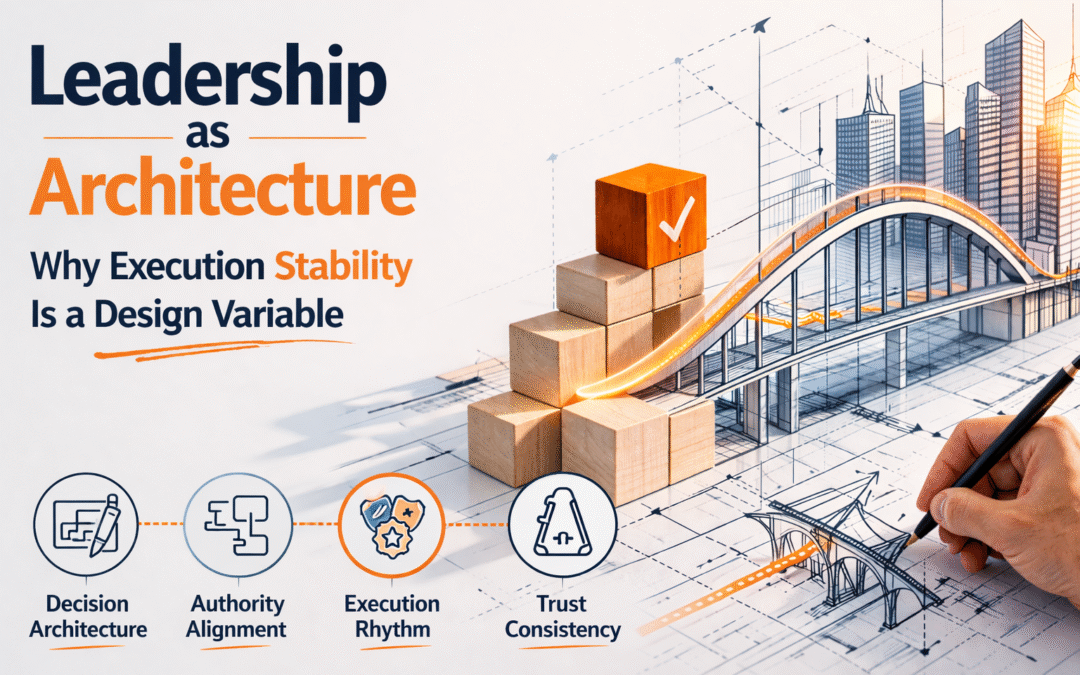
There are four interdependent conditions that shape execution stability:

Decision Architecture: Who decides, and how decisions move.

When decision ownership is unclear, execution slows, and escalation increases.

Authority Alignment: Whether responsibility is matched with the authority to act.

When authority and responsibility are misaligned, leaders become bottlenecks, and accountability is difficult to sustain.

Execution Rhythm: How work progresses without constant intervention.

When review cadence and progress checkpoints are inconsistent, execution relies on follow-up instead of structure.

Trust Consistency: How predictable leadership behavior is under pressure.

When expectations shift or standards are inconsistently applied, coordination slows, and hesitation increases.

These conditions do not operate independently.

Decision clarity enables execution. Authority alignment prevents bottlenecks. Execution rhythm sustains momentum. Trust consistency accelerates coordination.

When these conditions are aligned, execution stabilizes.

The Cost of Poor Design

When leadership is not intentionally designed, organizations compensate by increasing effort.

Leaders intervene more frequently. Decisions are escalated unnecessarily. Execution becomes inconsistent across teams.

The result is not always visible immediately. Over time, however, the organization experiences:

    • Slower decision cycles
    • Increased reliance on specific individuals
    • Reduced confidence in execution
    • Fragmentation across functions

These outcomes are often attributed to individuals. They are, more accurately, the result of structural ambiguity.

In high-stress environments, leadership behavior tends to reflect prior conditioning and practiced responses, reinforcing the importance of structured systems over reactive effort (Hannah et al., 2009).

Designing for Execution Stability

Improving execution does not begin with asking individuals to work harder or communicate more clearly. It starts with clarifying the conditions that govern workflow.

This includes:

    • Defining decision ownership explicitly
    • Aligning authority with responsibility
    • Establishing consistent execution rhythms
    • Reinforcing predictable leadership behavior

These are not one-time interventions but ongoing design choices that must be visible and sustained.

Implications for Leaders

Leaders are not only responsible for direction and influence. They are also responsible for creating conditions that enable others to act without hesitation.

When the conditions are unclear, leadership effort increases, and execution becomes fragile.

When conditions are well-designed, leadership is distributed, and execution becomes consistent.

The measure of leadership effectiveness is not how often intervention is required. It is how rarely it is.

Key Takeaway

Execution stability must not be viewed as a downstream outcome of strong leadership. It is a condition created by leadership.

When decision rights are clear, authority aligns with responsibility, and review rhythms are consistent, organizations do not rely on constant intervention to move work forward. Performance depends less on individual presence and more on shared clarity. This is the shift.

Leadership is not only expressed through direction or influence. It is expressed in how clearly decisions are defined, authority is aligned, and work can move without hesitation. Execution stability is not simply achieved. It is designed.

#Leadership

#Execution

#DecisionMaking

#OrganizationalEffectiveness

#Governance

References

Baumeister, R. F., & Tierney, J. (2012). Willpower: Rediscovering the greatest human strength.

Hannah, S. T., Uhl-Bien, M., Avolio, B. J., & Cavarretta, F. L. (2009). A framework for examining leadership in extreme contexts. The Leadership Quarterly, 20(6), 897-919.

Kahneman, D. (2011). Thinking, fast and slow. Farrar, Straus and Giroux.

Mintzberg, H. (1979). The Structuring of Organizations. In Readings in strategic management (pp. 322-352). London: Macmillan Education UK.

Simon, H. A. (2013). Administrative behavior. Simon and Schuster.

Leadership Is a Posture, Not a Platform

Leadership Is a Posture, Not a Platform

How you handle yourself when things get tough is more important than your position in the organization.

People typically associate leadership with visibility. They link leadership to titles, public roles, or having formal authority. However, authentic leadership is not about status. It shows up when you face challenges or get overlooked. Leadership is not something you announce. It is the set of characteristics others observe in your behavior and actions.1

Leadership is about how you carry yourself and the stance you take.

When Authority is Absent, Posture Remains

Posture remains when the stereotypical signs of leadership disappear. It is demonstrated in how you respond in difficult situations, such as being interrupted, corrected in public, ignored, or mistreated.2

You do not need a title to lead if you have a leadership posture. Even with authority, you can lose the ability to lead if your posture is lacking. This distinction is important because, too often, people wait for permission to lead. They hold back until they attain a new role, a promotion, or approval from a senior individual. Leadership actually begins much earlier, well before any audiences.3

Posture answers questions that a job title or role cannot answer:
Who are you when the situation calls for more than comfort or approval?It reveals your true character when things do not go as planned and when you must act without the safety net of authority. In these moments, your actions and decisions reflect your core values, not just your ambitions or desire for recognition.

Posture is Shown in Composure

Composure is one of the best ways to show leadership posture.

Staying calm is not necessarily the primary goal. Being composed under pressure shows self-control; It demonstrates the ability to manage emotions, see things clearly, and respond thoughtfully rather than react impulsively.

When things get tense, composure helps steady the environment. It helps to resolve conflicts and protect your dignity and others’ dignity.

Composure does not mean silence. It does not mean passivity. It is about showing restraint while staying clear about your intentions.

When some leaders lose composure, they resort to intimidating others or relying on their position to regain control. Authentic leaders with strong posture, however, stay true to their values.

Boundaries Reveal Posture

Another sign of a leadership posture is the ability to set boundaries without being hostile.

People often see boundaries as defiance, especially when someone without formal power sets them. But boundaries are really a form of self-leadership. They communicate what you will and will not accept, how you want to be treated, and non-negotiable standards.4

With proper posture, you can set boundaries that help you focus on your principles rather than your ego.

Boundaries matter even more in places where power is unequally distributed. An individual’s ability to say, “This does not align with how I choose to engage,” and stick to it, is an act of self-advocacy. It demonstrates strength of character and helps to shift the dynamic toward mutual respect, even when you do not hold formal authority. By consistently upholding your standards, you model the kind of leadership that inspires others to do the same.

Posture Shapes Culture

Mission statements do not shape culture.

People pay more attention to how leaders handle challenging situations than to their stated values. They deduce what is allowed, what is ignored, and what gets corrected from the leader’s posture. The leader’s behavior and actions set the standard. Hence, posture shapes culture.5, 6

A leader’s posture communicates:

  • Whether dignity is negotiable
  • Whether dissent is safe
  • Whether composure is expected or optional
  • Whether values are situational or consistent

Leadership failures rarely happen out of nowhere. They usually come from patterns established over time.7

Leadership Does not Require a Platform

One of the biggest myths about leadership is that you need a platform to have influence.

In reality, many important leadership moments happen out of the spotlight, in conversations, decisions, and actions that no one else sees.

With the proper posture, you can lead effectively even when no one is watching or applauding.
Posture helps to maintain integrity, even in the absence of recognition.

Posture is essential for experienced and emerging leaders, including those working in complicated organizations, and anyone who feels underestimated. Waiting for an official role before you start leading slows your growth and quietly chips away at your confidence.

Reframe

Leadership is a posture, and every moment is an opportunity to lead.

Every interaction tests alignment. Every response communicates values. Every decision either builds credibility or quietly erodes it.

The question then shifts from ‘Where do I lead?’ to ‘How do I show up?’

That shift is what makes leadership sustainable.

Reflection

Take a moment to consider the following questions:

  • Where are you relying on position rather than posture?
  • How do you respond when your authority is challenged or your dignity is tested?
  • What does your posture communicate to others about what is acceptable?

Leadership is not about having a title or waiting for permission. It is about staying consistently aligned with your values, especially when no one is watching.

If you are navigating leadership without an official title or maintaining your composure under pressure, you are not alone. These experiences are crucial to shaping your self-leadership.

SOURCES

1. Nouman, H., & Luria, G. (2025). Beyond formal authority: Cultural perspectives on informal leadership in social work practice. The British Journal of Social Work, 55(8), 3694–3713.

2. Liu, H., Chiang, J. T. J., Fehr, R., Xu, M., & Wang, S. (2017). How do leaders react when treated unfairly? Leader narcissism and self-interested behavior in response to unfair treatment. Journal of Applied Psychology, 102(11), 1590.

3. Gambill, T. (2025). Lead without a title: The power of informal leadership. Forbes.

4. Lofgren, J. (2021). The role that boundaries play in leadership growth. Forbes. 

5. Miraglia, Y. (2024). The role of leadership in shaping organizational culture. Journal of Organizational Culture, Communications and Conflict, 28(3), 1-3. 

6. Kamins, C. (2019). 3 daily actions that set the tone for workspace culture. Workplace.

Leadership in Action: Behaviors that Matter

Turning Awareness into Action

Bold Beginnings

The Audacity Leadership™ Newsletter is your briefing for bold, values-driven leadership. Bold leadership is built through consistent reflection and intentional action. In this first edition of 2026, we are focusing on transforming everyday experiences into a source of growth, influence, and clarity. Our goal is to help you lead boldly, with clarity, confidence, and conviction, regardless of your title, position, or starting point.

Leadership Lens – Everyday Audacity

Bold leaders do not just move through their days; they notice their moments. This means recognizing when you have influenced a decision, created space for another’s voice, navigated conflict with composure, or stood firm on values. By capturing these moments, you gain clarity on your leadership style, strengths, and areas to develop.

Resource Spotlight – The Confidence Self-Assessment

Your growth as a leader accelerates when you can see the patterns in your own actions. The Leadership Moment Tracker is a simple yet powerful tool that helps you: • Record situations where you demonstrated leadership • Reflect on what happened and patterns that emerge over time • Identify the action or mindset shift to carry forward.

Why it matters: Intentional tracking transforms leadership from something you hope you are doing well into something you can measure, refine, and strengthen.

Leadership Moment Tracker.pdf

Reflection

  • What leadership moments have you experienced in the past two weeks?

  • Which of those moments revealed a hidden strength?

  • How might you create more opportunities for similar moments?

Audacity in Action

When leaders share their process for capturing and learning from leadership moments, it encourages others to do the same. This creates a ripple effect of self-awareness, accountability, and shared growth across your team or community.

Lead Boldly – Quick Wins

Here are some quick actions and mindset resets you can apply immediately for a leadership boost:

One bold action to take this week
Share one recent leadership moment with your team and invite them to share theirs.
Why it matters: Open sharing builds trust, transparency, and a culture of reflection.

Your Clarity Phrase This Week
“Let’s pause and learn from what just happened.”
Why it matters: Pausing to reflect in the moment helps cement lessons and ensures they are acted upon, not just remembered.

One mindset reminder
Reflection without action is insight wasted.
Why it matters: Awareness is powerful, but it must translate into intentional change to make an impact.

Share This Issue

Enjoyed this issue? Forward it to someone who leads boldly.
Subscribe here →
Click here for further leadership insights

Your leadership journey deserves more than intention; it deserves action.
Book your complimentary Discovery Session below and begin leading boldly with clarity, confidence, and conviction.

Until next time, lead boldly, lead audaciously!

Connect

Stay connected for insights that help you lead with clarity, confidence, and conviction:
Tag us: #AudacityLeadership #DrBolaFashola