Leadership is often evaluated through the lens of vision, influence, or individual capability.
However, in many organizations, performance does not falter due to intent; rather, it fails when execution relies on individual personalities rather than effective design.
This is a structural problem, not a motivational one. Execution stability is not merely an outcome. It is a variable that must be intentionally designed.
Where Execution Actually Breaks
In most organizations, work advances until a need for clarity arises. At that point, execution slows.
Decisions are revisited. Ownership becomes ambiguous. Escalation becomes the default rather than the exception.
The issues are rarely recognized as structural. They are often labeled as communication failures, skill gaps, or isolated leadership challenges. However, these explanations overlook the underlying pattern.
Execution breaks where the system depends on individual intervention to move forward.
When progress depends on continual leadership involvement, the problem is not effort but design.
Execution breaks where clarity is required but not defined. In these moments, individuals rely more heavily on fast, pattern-based thinking shaped by cognitive shortcuts and limited information (Kahneman, 2011).
The Limits of Leadership as Capability
Leadership is frequently framed as a function of individual skill:
-
- Stronger communication
- Better alignment
- Increased accountability
These skills are necessary but not sufficient.
When decision rights are unclear and authority is misaligned, even skilled leaders struggle to maintain consistent execution. They compensate by:
-
- Stepping into decisions
- Increasing oversight
- Reinforcing expectations informally
Over time, this approach creates dependency. Execution must then be actively maintained rather than structurally sustained. The organization starts to depend on specific individuals rather than on system clarity. Performance becomes less a function of intention and more a function of habit and environmental structure shaping behavior (Baumeister & Tierney, 2012).
Leadership as Architecture
A new perspective is essential. Leadership should be viewed not only as a set of behaviors but also as a form of design.
The question shifts from “How do we lead more effectively?” to “What conditions have been created that determine how leadership functions?”
These conditions are not abstract. They are evident in how decisions are made, how authority is exercised, how work progresses, and the consistency of leadership behavior.
Decision-making is constrained by structural design and the limits of available information, rather than individual capability alone (Simon, 1947; Mintzberg, 1979).
The Four Conditions That Shape Execution
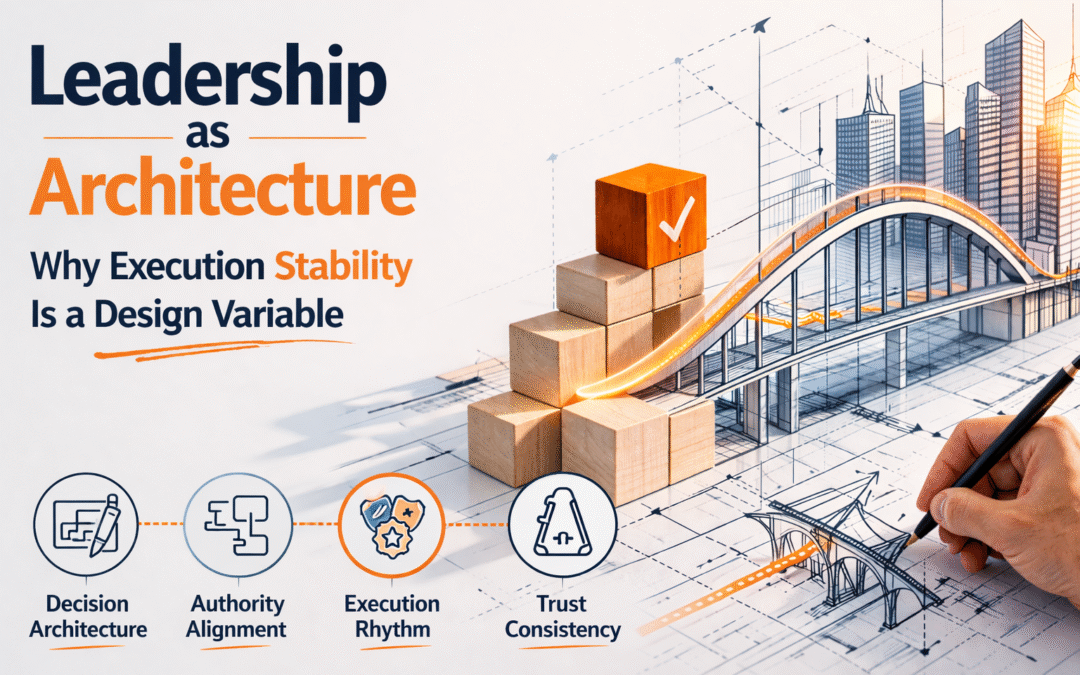
There are four interdependent conditions that shape execution stability:
Decision Architecture: Who decides, and how decisions move.
When decision ownership is unclear, execution slows, and escalation increases.
Authority Alignment: Whether responsibility is matched with the authority to act.
When authority and responsibility are misaligned, leaders become bottlenecks, and accountability is difficult to sustain.
Execution Rhythm: How work progresses without constant intervention.
When review cadence and progress checkpoints are inconsistent, execution relies on follow-up instead of structure.
Trust Consistency: How predictable leadership behavior is under pressure.
When expectations shift or standards are inconsistently applied, coordination slows, and hesitation increases.
These conditions do not operate independently.
Decision clarity enables execution. Authority alignment prevents bottlenecks. Execution rhythm sustains momentum. Trust consistency accelerates coordination.
When these conditions are aligned, execution stabilizes.
The Cost of Poor Design
When leadership is not intentionally designed, organizations compensate by increasing effort.
Leaders intervene more frequently. Decisions are escalated unnecessarily. Execution becomes inconsistent across teams.
The result is not always visible immediately. Over time, however, the organization experiences:
-
- Slower decision cycles
- Increased reliance on specific individuals
- Reduced confidence in execution
- Fragmentation across functions
These outcomes are often attributed to individuals. They are, more accurately, the result of structural ambiguity.
In high-stress environments, leadership behavior tends to reflect prior conditioning and practiced responses, reinforcing the importance of structured systems over reactive effort (Hannah et al., 2009).
Designing for Execution Stability
Improving execution does not begin with asking individuals to work harder or communicate more clearly. It starts with clarifying the conditions that govern workflow.
This includes:
-
- Defining decision ownership explicitly
- Aligning authority with responsibility
- Establishing consistent execution rhythms
- Reinforcing predictable leadership behavior
These are not one-time interventions but ongoing design choices that must be visible and sustained.
Implications for Leaders
Leaders are not only responsible for direction and influence. They are also responsible for creating conditions that enable others to act without hesitation.
When the conditions are unclear, leadership effort increases, and execution becomes fragile.
When conditions are well-designed, leadership is distributed, and execution becomes consistent.
The measure of leadership effectiveness is not how often intervention is required. It is how rarely it is.
Key Takeaway
Execution stability must not be viewed as a downstream outcome of strong leadership. It is a condition created by leadership.
When decision rights are clear, authority aligns with responsibility, and review rhythms are consistent, organizations do not rely on constant intervention to move work forward. Performance depends less on individual presence and more on shared clarity. This is the shift.
Leadership is not only expressed through direction or influence. It is expressed in how clearly decisions are defined, authority is aligned, and work can move without hesitation. Execution stability is not simply achieved. It is designed.
#Leadership
#Execution
#DecisionMaking
#OrganizationalEffectiveness
#Governance
References
Baumeister, R. F., & Tierney, J. (2012). Willpower: Rediscovering the greatest human strength.
Hannah, S. T., Uhl-Bien, M., Avolio, B. J., & Cavarretta, F. L. (2009). A framework for examining leadership in extreme contexts. The Leadership Quarterly, 20(6), 897-919.
Kahneman, D. (2011). Thinking, fast and slow. Farrar, Straus and Giroux.
Mintzberg, H. (1979). The Structuring of Organizations. In Readings in strategic management (pp. 322-352). London: Macmillan Education UK.
Simon, H. A. (2013). Administrative behavior. Simon and Schuster.